Summary
When teams ask AI where to work in Singapore, the answers are not neutral.
In this study we ran 25 realistic workspace questions through ChatGPT and tracked how often 33 coworking and flex brands were mentioned, how positively they were described, and where they appeared in each answer. The result is an early view of the AI visibility landscape—a signal of which brands AI already trusts, and which are currently absent from the conversation.
- First, a small group of five brands—JustCo, Spaces, Regus, WeWork, and Servcorp—dominate AI visibility, appearing in over 80% of all scenarios and consistently ranking in top positions.
- Second, on-demand access platforms like workbuddy, Deskimo, and Switch are over-represented relative to their physical footprint, capturing attention in flexibility-focused queries despite limited locations.
- Third, 14 out of 33 operators—42% of the market—are effectively invisible in AI answers, meaning they are not being surfaced when potential clients ask AI for workspace recommendations .
This is not a verdict on quality or fit. It is a signal of where decision-making conversations are happening, and who is present when they begin.
Why AI Visibility Matters
Workspace decisions start in search and AI assistants long before anyone fills out a tour form. Corporate buyers, finance teams, and HR leads are using ChatGPT, Perplexity, and Google AI Overviews to build their shortlists, compare pricing models, and frame their evaluation criteria before they ever land on a provider's website. AI visibility is distinct from traditional search rankings. It measures three dimensions:
- Appearing in answers: Whether a brand is mentioned when relevant workspace questions are asked
- Described positively: How favorable the sentiment and context are when the brand appears
- Positioned in the shortlist: Where the brand ranks when AI actively recommends options
If you're not present in AI answers today, you are gifting attention to competitors. The brands that establish AI visibility now will compound that advantage as these tools become the default research layer for enterprise and SME buyers. This is not speculative—it is already happening in procurement workflows, remote work planning, and hybrid strategy design.
What metrics we track?
We designed 25 prompts across five realistic decision themes: workspace selection and comparison, cost and contract negotiation, hybrid work strategy, productivity and team culture, and local on-demand logistics. Each prompt was run through ChatGPT (GPT-5), and we tracked every mention of 33 Singapore coworking and flex space brands .
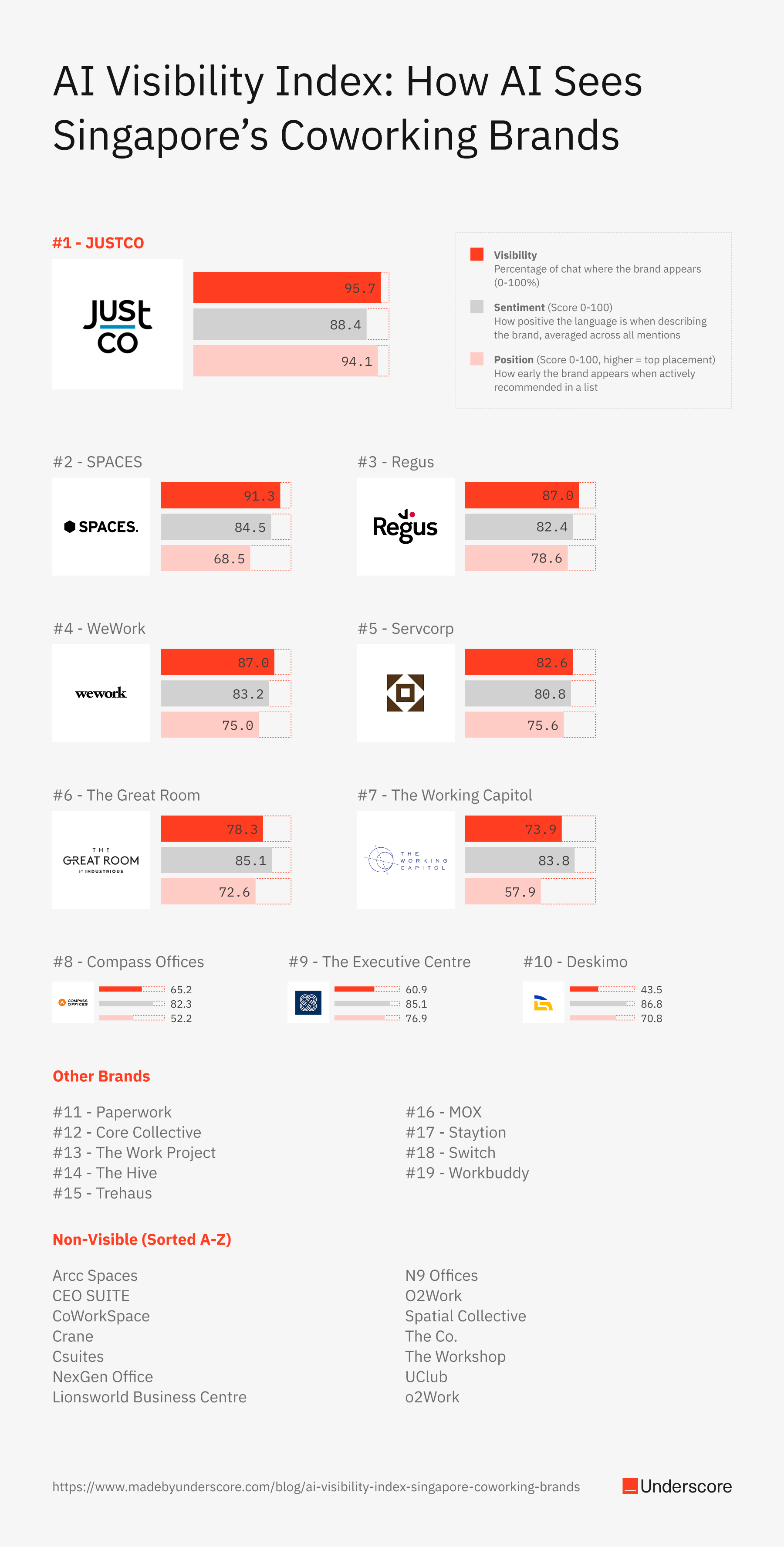
We measured three core metrics for each brand :
- Visibility: Percentage of prompts where the brand appears (0-100%)
- Sentiment: How positive the language is when describing the brand, averaged across all mentions (Score 0-100)
- Position: How early the brand appears when actively recommended in a list (Score 0-100, where higher = earlier placement)
These three dimensions combine to reveal which brands AI trusts, recommends positively, and positions prominently in workspace conversations.
What are the prompts used?
We classify the prompts into 5 main topics and these are some of the examples:
- Workspace selection: "Compare premium coworking options in Singapore suitable for a 120 person regional HQ team"
- Cost & contracts: "Estimate the total monthly cost of moving 50 staff from a traditional lease into coworking"
- Hybrid strategy: "Help me design a flexible office strategy that mixes HQ space and coworking"
- Productivity: "Recommend a weekly routine for a remote worker who splits time between home, coworking spaces and client meetings"
- On-demand logistics: "Find affordable coworking or study spaces near my home MRT"
How we limit the test?
API vs. Chat Interface: This study was conducted using ChatGPT's API, which may produce different results from the actual chat interface available at chatgpt.com. The web interface includes additional system-level instructions, hidden prompts, and post-processing features designed to optimize user experience that are not present in raw API calls. The API provides unadorned model outputs, while the web interface applies contextual enhancements that may influence which brands appear and how they are described.
Model-Specific Results: The sources, examples, and recommendations provided by AI models vary based on their training data, retrieval mechanisms, and update cycles. Results from GPT-5 (used in this study) may differ from other versions of ChatGPT, Claude, Perplexity, or Google's AI Overviews. Each model maintains different knowledge bases and may prioritize different sources when generating recommendations
Point-in-Time Snapshot: This analysis represents a single snapshot conducted on December 2, 2025 . AI model knowledge, ranking algorithms, and brand visibility can shift rapidly as models are updated and as brands publish new content. Weekly or bi-weekly monitoring is recommended to track changes in AI visibility over time and respond to emerging patterns before they solidify.
Prompt Dependency: The 25 prompts used in this study represent common workspace decision scenarios but may not align perfectly with your specific target persona or ideal customer journey. Brands optimized for different use cases, buyer personas, or industry verticals may perform differently with alternate prompt sets. Custom prompt audits tailored to your positioning can reveal more precise visibility gaps and opportunities.
Overall Leaderboard
Who are the top 10 brands?
JustCo and WeWork currently anchor most SME and startup scenarios in AI answers, with JustCo achieving near-universal visibility at 96% of all prompts and the strongest position score (94.1). Spaces and Regus demonstrate strong cross-category appeal, appearing consistently in both enterprise HQ queries and startup-focused scenarios with visibility above 87%.
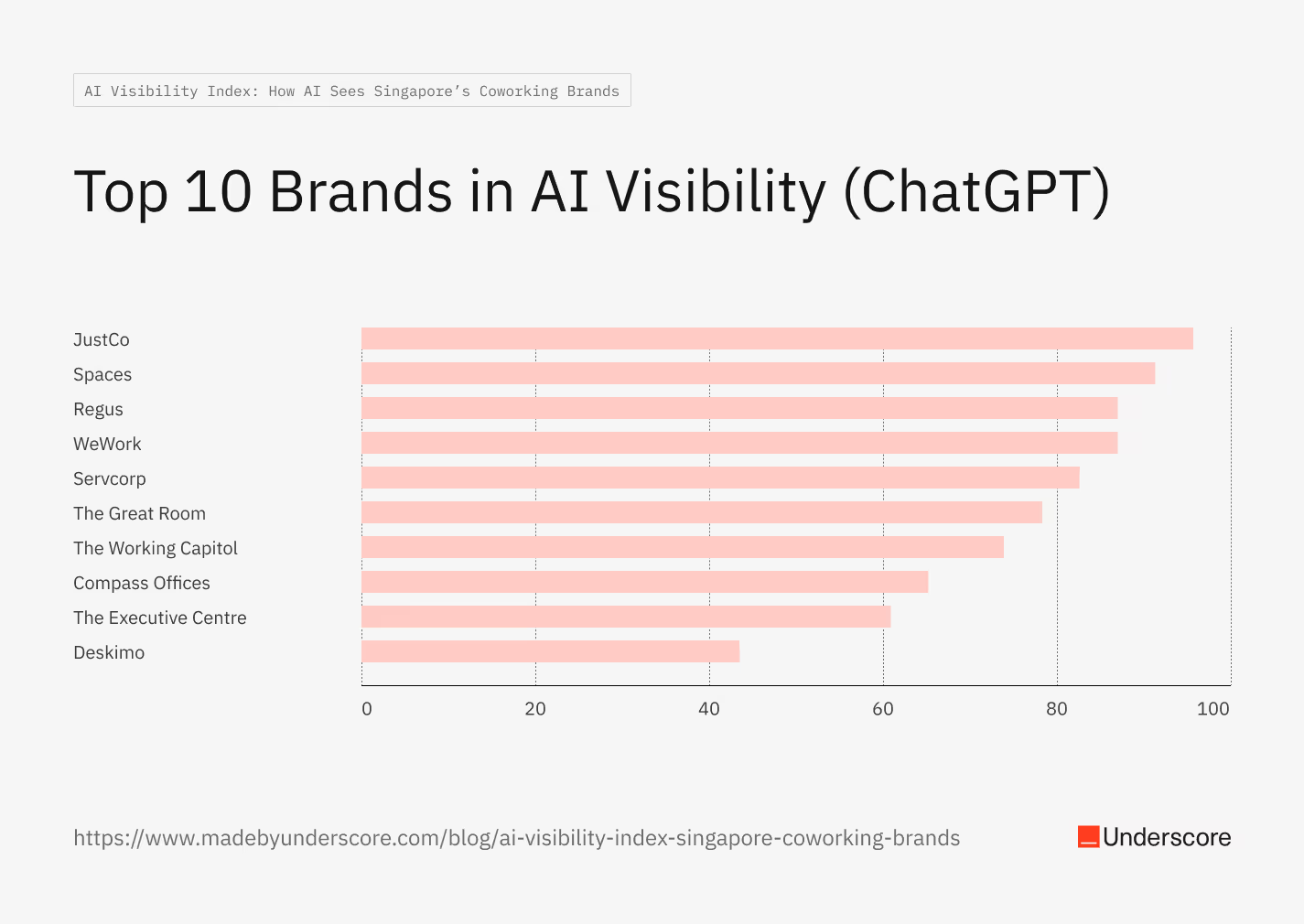
Notably, workbuddy, Deskimo, and Switch are over-indexing on visibility relative to their physical footprint, especially in on-demand and remote-work use cases where flexibility is explicitly prioritized . While Deskimo appears in 43.5% of prompts, workbuddy and Switch achieve strong position scores (92.3 and 84.6 respectively) despite appearing in only 4.3% of prompts—when they show up, they rank early.
Several established operators do not appear at all—including CEO SUITE, Csuites, Lionsworld, and Arcc Spaces—which is a strategic gap rather than a verdict on quality . The detail sits in the categories.
Category Deep Dives
Enterprise & HQ-Grade Flex
All other enterprise brands showed 0% visibility
Key insights:
- The Executive Centre, Regus, and Servcorp form the default shortlist for HQ-style queries involving large teams, premium locations, and serviced office requirements, each appearing in 60-87% of enterprise scenarios
- The Great Room benefits from strong sentiment (85.1) and is positioned as a hospitality-led premium option when ambiance and design matter
- The Executive Centre achieves the strongest position score (76.9) in this category despite lower visibility (60.9%), meaning when it appears, it ranks early
- Six enterprise-focused brands—including CEO SUITE, Csuites, and Lionsworld Business Centre—are completely absent from AI answers
What this means if you're in this category: Enterprise clients often begin research by asking AI to compare "premium" or "serviced office" options. If your brand doesn't appear in those early conversations, you're excluded from consideration before the tour request stage.
SME & Startup Coworking
Key insights:
- JustCo dominates the SME and startup category, appearing in nearly every relevant scenario (95.7% visibility) and holding the strongest position score (94.1) across all brands
- Spaces and WeWork both exceed 87% visibility, demonstrating cross-category appeal in both enterprise and startup queries
- Core Collective and Trehaus show strong positive sentiment (85.0+) but lower visibility (13-35%), suggesting they are well-regarded when mentioned but not consistently surfaced
- The Working Capitol maintains steady visibility at 73.9%, positioning itself as a reliable alternative to the top three
What this means if you're in this category: Startup and SME queries often frame questions around "flexible coworking," "growing teams," or "community-focused spaces." JustCo and WeWork have locked in these keywords. To break through, you need differentiation that AI can clearly articulate—whether that's industry focus, hybrid models, or specific amenities.
Individual & On-Demand Access
Key insights:
- Deskimo consistently appears in on-demand scenarios when flexibility, affordability, or day-pass access is the brief, with 43.5% visibility and the highest sentiment score in this category (86.8)
- workbuddy and Switch appear far less frequently (4.3% visibility each) but achieve exceptional position scores (92.3 and 84.6) when they do—meaning AI ranks them very early in the few scenarios where they appear
- All on-demand brands that appear are described positively (sentiment 85+), suggesting AI understands their positioning but defaults to Deskimo first
- This category shows the strongest over-indexing effect: these platforms have outsized AI visibility relative to their physical footprint because they solve a specific, well-defined problem
What this means if you're in this category: On-demand operators have an advantage in AI visibility if their value proposition is crisp. "Find me flexible day passes" or "work near my location" queries align well with platform-based models. Ensure AI can clearly differentiate your offering from Deskimo, which currently dominates this conversation.
What Brands Can Do Next
If You're Already Highly Visible
Protect and extend your position. Align content and partnerships with the scenarios where AI already prefers you. For brands like JustCo, WeWork, Regus, and Servcorp, the priority is maintaining visibility across evolving query types—especially as buyers ask more nuanced questions about hybrid work, ESG credentials, or tech integration. Monitor sentiment closely and ensure new locations, services, and pricing updates are discoverable by AI systems.
If You Show Up Occasionally
Clarify your positioning, clean up your signals, and create content around the specific questions where AI is still defaulting to others. Brands like Core Collective, Paperwork, Compass Offices, and The Work Project appear in some scenarios but lack consistent visibility. This suggests your differentiation isn't yet clear to AI. Focus on structured content that answers buyer questions directly. Make it easy for AI to recommend you in specific, valuable contexts.
If You Are Currently Invisible
Treat this as an early-warning signal. You are not being considered in AI-led discovery journeys yet. This doesn't reflect your product quality—it reflects your digital footprint and how clearly your positioning is communicated online. Start by auditing what AI currently knows about you (run your own prompts), identify where competitors appear instead of you, and build content that fills those gaps. The good news: AI visibility compounds over time, and early action creates durable advantage.
Partner With Us
We help teams to audit their current AEO standing, identify quick wins, and design content and data changes that compound over time across ChatGPT, Perplexity, and Google AI Overviews. Our approach combines structured data optimization, targeted content strategy, and continuous monitoring to ensure your brand appears—and ranks well—when decision-makers ask AI where to work. AI is already shaping how workspace options are framed for decision-makers. The brands that treat AI visibility as a channel today will compound that advantage over the next three years
This study captured one model, one market, and one moment in time. But the pattern is clear: AI assistants are becoming the first filter in enterprise buying journeys, and visibility in those early conversations determines who makes the shortlist—and who doesn't get considered at all.