Executive Summary
As founders build their Singapore companies, AI has become a consultation partner in banking decisions. When entrepreneurs ask where to open a business account, how to manage multi-currency flows, or which providers offer team spend controls, AI assistants surface a shortlist of trusted names as a first step in their research.
This study analyzed 25 business account providers across 25 prompts using GPT-5 to measure how brands appear when Singapore's digital-first SME operators consult AI for banking advice.
Key Findings:
- DBS Bank ranked first among all providers with perfect 100% visibility, appearing in every single prompt tested, while fintech challengers Aspire, Airwallex, and Wise Business matched this coverage.
- Digital banks vanished completely from AI recommendations. GXS Bank, MariBank, ANEXT Bank, and Green Link Digital Bank recorded zero mentions across all 25 prompts despite holding full banking licenses.
- Fintechs dominated cross-border and card spend conversations, with Airwallex scoring 87.9 sentiment and 85.6 position, higher than any traditional bank, when founders asked about international payments and team expense controls.
AI trusts, describes positively, and positions early. For business banking in Singapore, that trust now flows to a tight group of local incumbents and fintech challengers who have built legible, well-documented service narratives.
Why AI Visibility Matters
AI assistants have become a primary consultation point for decision-making in business banking. Founders increasingly turn to ChatGPT or Claude to request account recommendations, draft comparisons, or design two-account setups. The brands that appear in those conversations capture attention at the moment intent forms.
Who We Tested For
Persona: "Kai, the Digital-First SME Operator"
Kai runs a Singapore-registered SME or startup with 1 to 30 employees, 6 months to 5 years old, with revenue already flowing. The company operates in services (agency, consultancy), ecommerce, SaaS, trading, or content businesses. Revenue comes mostly from card and transfer activity, with recurring invoices, marketplace payouts, or overseas clients. Kai needs to open an account fast with minimal paperwork, pay vendors and contractors internationally, reduce FX and transfer costs, and maintain clean team spend controls with exports that reconcile in Xero or QuickBooks. The core pain points include slow traditional banks with opaque fees, FX spreads eating margin, cashflow swings, messy expense tracking, and compliance surprises.
Methodology
This study tested 25 business banking providers across 25 prompts organized into five core themes: Account opening and eligibility, Fees and total cost, Multi-currency and cross-border, Cards and spend controls, and Compliance and reliability. Each prompt simulated a real question a Singapore founder would ask when evaluating business accounts. We recorded every brand mention, its rank when recommended, the sentiment of the description, and whether it was actively recommended or merely mentioned.
The model tested was GPT-5, accessed via API in December 2025.
Scoring Definitions:
- Visibility: Percentage of prompts where the brand appears (0–100%).
- Sentiment: How positive the language is when describing the brand, averaged across all mentions (Score 0–100).
- Position: How early the brand appears when actively recommended in a list (Score 0–100, where higher equals earlier placement).
These three dimensions combine to reveal which providers AI trusts, recommends positively, and positions prominently in business banking conversations.
Sample Prompts
- Account opening and eligibility:"Which business accounts in Singapore can be opened fully online, and what are the usual eligibility criteria?"
- Fees and total cost: "Explain FX spread vs transfer fee with a simple example, and how to estimate total cost for overseas payments."
- Multi-currency and cross-border: "I invoice in foreign currencies. What's the best setup to receive, hold, convert, and pay internationally with low friction?"
- Cards and spend controls: "I need team cards with per-person limits and visibility. What capabilities should I look for?"
- Compliance and reliability: "What typically triggers account reviews or freezes for business accounts, and how can I reduce the risk?"
Study Limitations
- API vs. Chat Interface: Results reflect API behavior and may differ slightly from conversational outputs users see in ChatGPT or Claude.
- Model-Specific Nuances: GPT-5 was tested. Other models (Claude, Gemini, Perplexity) may prioritize different brands based on training data and retrieval methods.
- Point-in-Time Data: This analysis captures AI behavior in December 2025. Brand visibility can shift as models retrain and providers publish new content.
Overall Leaderboard
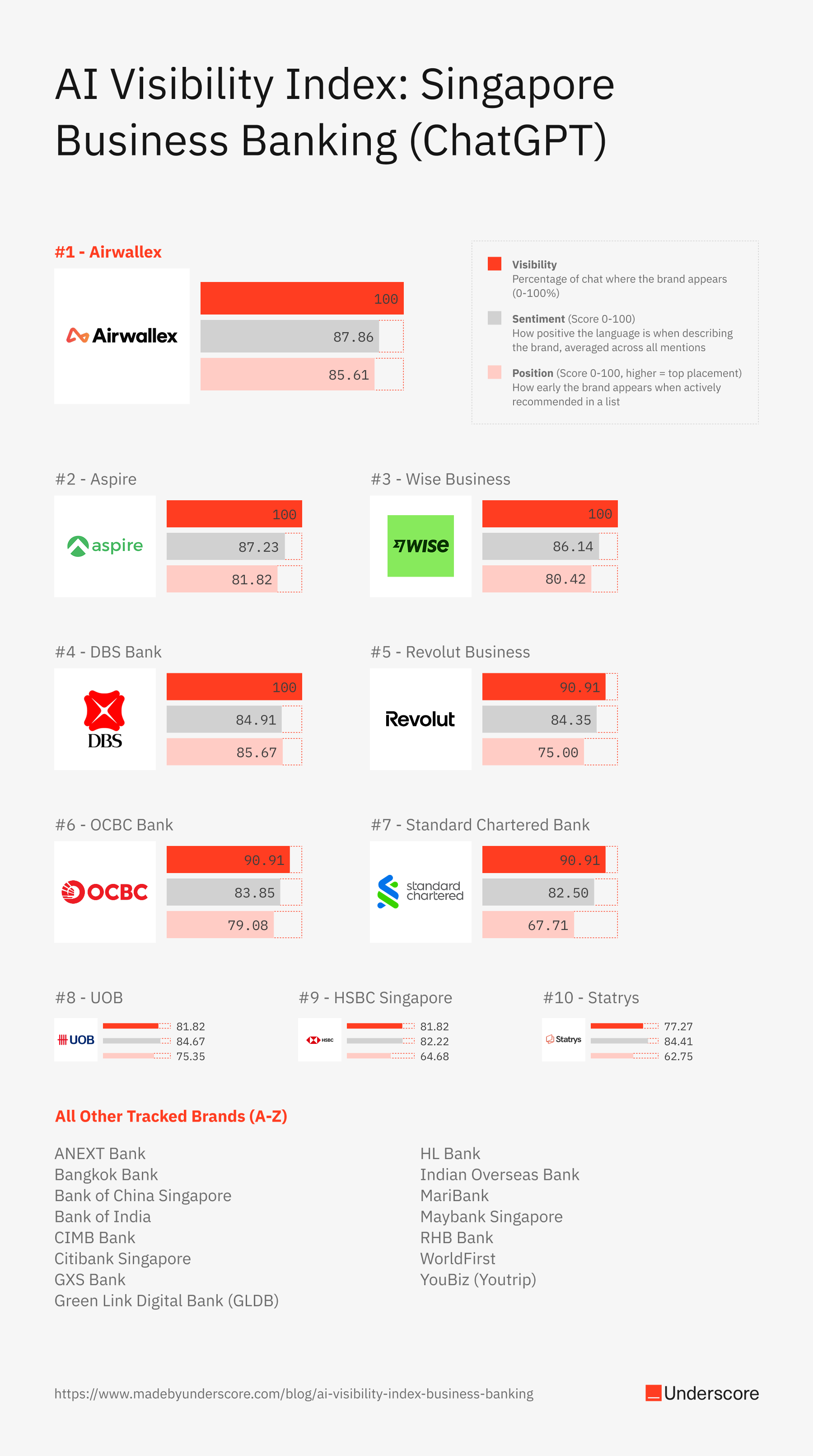
Four brands achieved perfect visibility. DBS Bank, Aspire, Airwallex, and Wise Business each appeared in all 25 prompts tested. DBS combined ubiquity with the strongest position score (85.7), meaning it appeared early in recommendation lists across account opening, compliance, and multi-currency themes. Airwallex led sentiment at 87.9, described with "very positive" language when AI surfaced it for cross-border payments and FX policy questions. OCBC and Standard Chartered both hit 90.9% visibility, missing only niche prompts, while Revolut Business matched that coverage with slightly higher sentiment than the foreign banks. UOB and HSBC Singapore reached 81.8% visibility, recommended for operational reliability and international capabilities, positioned later in lists than the top tier. Statrys rounded out the top 10 with 77.3% visibility, strong sentiment (84.4), and a clear fintech positioning for multi-currency SME needs.
15 brands not shown. View the full dataset including Citibank Singapore, Maybank Singapore, CIMB Bank, WorldFirst, YouBiz, and others at the landing page.
Local Full Bank
Insights:
- DBS Bank swept the local category, appearing in every prompt and ranking first or second in 19 of 22 total mentions. AI consistently described DBS as the "leading local bank" and "market-leading" with "extensive SME services" and "strong integration with corporate banking tools".
- All three local banks exceeded 81% visibility, meaning AI recommended them across account opening, compliance, multi-currency, and card spend themes. Their sentiment scores clustered tightly (83.9 to 84.9), reflecting uniform trust language.
- Position scores separated the pack. DBS averaged rank 3.6 when recommended, OCBC averaged 4.8, and UOB averaged 5.4, showing that AI consistently placed DBS at the top of recommendation lists.
Digital Bank
Digital banks recorded zero AI visibility across all 25 prompts, including themes where their digital-first onboarding and SME focus would position them as natural recommendations. GXS Bank, MariBank, ANEXT Bank, and Green Link Digital Bank were never mentioned by GPT-5. When AI answered prompts about opening accounts fully online or within 7 days, it recommended Aspire, Airwallex, Wise Business, Revolut Business, and Statrys rather than licensed digital banks. Digital banks launched in 2022 to 2023 with regulatory approval and consumer traction, yet their web presence, third-party mentions, and content footprint remain below the threshold where AI models trust them as answers to founder questions. All four digital banks tested (GXS Bank, MariBank, ANEXT Bank, and Green Link Digital Bank) scored identically at zero across visibility, sentiment, and position dimensions. Access full zero-mention analysis and recommendations for this category at the landing page.
Foreign Full Bank
Insights:
- Standard Chartered and HSBC dominated foreign bank visibility, appearing in over 80% of prompts with language emphasizing "international trade," "multi-currency," and "global network". Both scored above 82 sentiment, yet position scores (67.7 and 64.7) lagged behind local banks and fintechs, meaning AI placed them later in recommendation lists.
- Citibank visibility dropped to 63.6%, missing entire prompt themes around card spend controls and fast onboarding, where AI favored fintechs and local banks instead. When Citibank did appear, sentiment remained high (82.1) with descriptions like "global corporate services" and "cash management".
- Regional banks (Maybank, CIMB) fell below 40% visibility, recommended primarily in prompts about ASEAN-focused businesses or regional trade corridors. Their sentiment scores (79.3 to 81.3) trailed the category leaders by 2 to 3 points, reflecting language like "practical option" and "regional banking" rather than "top choice" or "recommended".
Omitted brands: Bank of China Singapore , RHB Bank , Bangkok Bank, Indian Overseas Bank, Bank of India , and HL Bank did not make the top 5. View the full foreign bank dataset including zero-mention providers at the landing page.
Fintech/Payment Institution
Insights:
- Aspire, Airwallex, and Wise Business achieved perfect visibility, matching DBS Bank as the only providers to appear in all 25 prompts. AI described them as "top choice," "ideal," and "well-suited" across account opening, FX, card spend, and compliance themes.
- Fintech sentiment scores led the entire study, with Airwallex at 87.9, Aspire at 87.2, and Wise at 86.1, higher than any bank category. Language emphasized "low-cost," "transparent FX rates," "fast onboarding," and "granular spend controls," mirroring the pain points of the target persona.
- Revolut and Statrys crossed 75% visibility, recommended frequently for multi-currency accounts and team card controls, though position scores (75.0 and 62.7) showed AI placed them after the top-tier fintechs when listing options.
Omitted brands: WorldFirst and YouBiz (Youtrip) did not make the top 5. Both appeared in niche prompts about FX-focused accounts and travel/expense cards, respectively, yet lacked the broad coverage of the leading fintechs. Access the full fintech leaderboard at the landing page.
Strategic Conclusion
AI has reordered the business banking consideration set in Singapore. When founders ask where to open an account, which provider offers the best FX rates, or how to manage team spend, AI surfaces a shortlist of four providers with perfect visibility (DBS Bank, Aspire, Airwallex, and Wise Business) as a primary research step. Local incumbents (OCBC, UOB) and foreign banks (Standard Chartered, HSBC) maintain strong presence, yet trail in position scores, meaning they appear later in recommendation lists. Fintechs dominate sentiment language with "low-cost," "transparent," and "fast" descriptions that match persona pain points. Digital banks vanished entirely, recording zero mentions despite holding full licenses and SME product lines.
Our perspective: AI visibility compounds. Brands that appear early in recommendations capture founder attention at the moment intent forms. The trust gap between visible and invisible providers cannot close through paid ads or sales outreach alone. It requires deliberate content strategy, third-party mentions, and clear service narratives that AI models can parse and trust. For business banking providers, the window to build AI legibility remains open, narrowing as competitors invest in structured content and earned coverage.
Partner With Us
AI visibility does not fix itself. Underscore works with financial services providers to diagnose AI visibility gaps, build content strategies that models trust, and measure improvement across prompt themes and personas. If your brand scored below 50% visibility or missed entire prompt categories, we can show you the specific gaps AI sees and the content moves that close them.
Let's build your AI visibility strategy. Contact us to request your brand's full prompt-by-prompt breakdown and tailored recommendations.