Key Takeaways:Google AI Overviews now appear in roughly 30% of US search results and are expanding globally. Organic clicks have dropped by up to 42% on queries where AIOs appear. There is only 17% overlap between AI Overview citations and traditional Page 1 rankings. Brands that treat AI visibility as a system of signals, rather than a single tactic, will be best positioned to maintain and grow search traffic in 2026 and beyond.
What Are Google AI Overviews?
Google AI Overviews (AIOs) are AI-generated summaries that appear at the top of Google search results. They pull information from multiple web sources and present a synthesised answer directly on the search page, before any traditional organic links.
You have probably seen them already. Search for something like "best CRM for small businesses" or "how to reduce employee turnover" and Google may show a multi-paragraph summary with cited sources, right above the blue links.

Google first introduced AI Overviews under the name Search Generative Experience (SGE) in May 2023. After a year of testing in Search Labs, the feature officially launched to all US users in May 2024 under the current name. It has since expanded to over 200 countries and territories globally.
AI Overviews are different from featured snippets. Featured snippets pull a single block of text from one source. AI Overviews synthesise information from multiple pages into a cohesive answer, with inline citations linking to the sources used. They are longer, more detailed, and fundamentally change how users interact with the search results page.
Timeline: How AI Overviews Evolved
Understanding where AI Overviews came from helps explain where they are going.
Why Should Brands Care About AI Overviews?
If your business depends on Google for traffic, leads, or sales, AI Overviews are changing the rules. The search page your customers see today looks fundamentally different from a year ago.
Here is the core problem: if Google answers your customer's question directly on the search page, your customer may never visit your website.
The data supports this. Research from Define Media Group found that AI Overviews cause an average 42% reduction in organic clicks. An earlier Ahrefs study measured a 34.5% click reduction. The exact number varies by query type and industry, but the direction is consistent. AI Overviews are absorbing clicks that used to go to websites.
For businesses, this matters in several specific ways:
- Service-based businesses (legal, accounting, consulting) that rely on informational content to attract leads will see fewer visitors from "how to" and "what is" queries.
- E-commerce brands face a new threat: AI Overviews now appear in 14% of shopping-related queries, up 5.6 times in just four months. Google is also testing AI-generated product landing pages that could bypass your product pages entirely.
- B2B companies with long sales cycles depend on being discovered during the research phase. If AI Overviews summarise your competitor's content instead of yours, you lose mindshare before the prospect even knows you exist.
The brands that lose are the ones that do nothing. And the ones that underperform are the ones that treat AI visibility as a single problem with a single fix.
In practice, AI systems don't recommend brands based on one factor. They cross-reference multiple signals: how clear your positioning is, how well your site is structured for AI agents, how consistently third parties validate your expertise, and whether your content is built to be cited or just read. The brands that get this right treat AI visibility as a system, not a tactic.
How Do AI Overviews Work?
AI Overviews use Google's Gemini model to generate responses. When a user enters a query, the system:
- Identifies relevant web pages using Google's existing search index and ranking signals.
- Extracts and synthesises information from multiple sources into a cohesive summary.
- Generates inline citations linking back to the source pages.
- Applies safety filters to reduce hallucinations, medical misinformation, and harmful content.
Google has stated that AI Overviews are designed to be "built on top of" traditional search, meaning they rely on the same core index and quality signals that power organic results. Pages that rank well organically have a higher probability of being cited in AI Overviews.
That said, the overlap is far from perfect. BrightEdge found that only 17% of URLs cited in AI Overviews also appear in the top 10 organic results. This means AI Overviews are drawing from a wider pool of sources than what traditional SEO surfaces.
What triggers an AI Overview?

AI Overviews do not appear on every search. Google selectively shows them based on query type and predicted usefulness. They are most common on:
- Informational queries ("what is," "how to," "best practices")
- Complex multi-part questions
- Comparison queries ("X vs Y")
- Queries where Google believes a synthesised answer adds value beyond a single blue link
They are less common on navigational queries (where the user clearly wants a specific website) and simple factual lookups already handled by Knowledge Panels.
Google also tests and removes AI Overviews from queries where user engagement is low. This suggests the feature is being refined dynamically. Not every query will keep its AI Overview permanently.
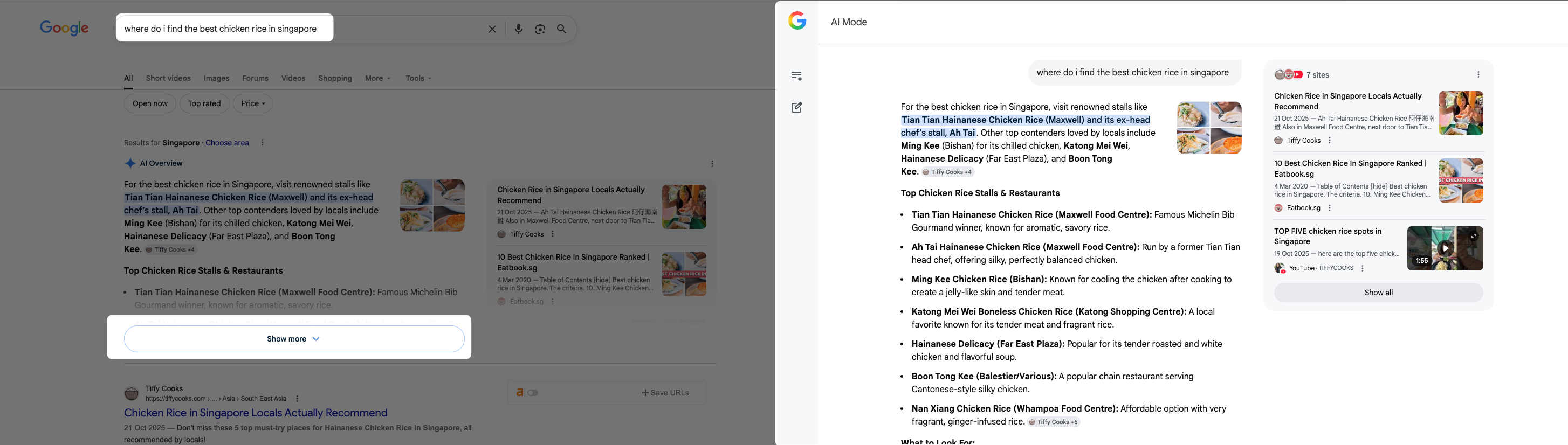
In our example seen above, we tried finding chicken rice in Singapore but using two different ways to write. The traditional way of searching using the term "Best chicken rice in singapore" and how people may search in AI tools "where do i find the best chicken rice in singapore". The latter triggers an AI Overview while the prior doesn't.
How Do AI Overviews Impact Search Results?
The impact is measurable and significant across three dimensions.
Click-through rates are dropping
Define Media Group's March 2026 research found a 42% average reduction in organic clicks when an AI Overview is present. An earlier Ahrefs study measured 34.5%. The decline is steeper for informational queries, where the AI Overview often provides a complete answer.
The bright spot: breaking news and trending queries actually saw a 103% increase in traffic. AI Overviews for rapidly evolving topics tend to drive more clicks because users want the latest information, and the AI summary alone isn't enough.
Impression counting has changed
Google now counts the same URL in both the AI Overview citation and the organic results as a single impression. This means your Search Console data may show higher click-through rates than before, but only because the denominator (impressions) has been consolidated. Actual traffic may still be down even if your CTR looks stable.
This is important for any brand monitoring their SEO performance. A rising CTR in Search Console does not necessarily mean more people are clicking through to your site. Always cross-reference with actual sessions in Google Analytics.
SERP real estate is shrinking
When an AI Overview occupies the top of the page, organic results are pushed further down. On mobile, the first organic result may require several scrolls to reach. This makes position 1 less valuable than it used to be for queries where AI Overviews appear.
The combination of these three effects creates a new reality: ranking well on Google is necessary but no longer sufficient. You also need to be cited within the AI Overview itself, or risk losing visibility even if your organic rankings haven't changed.
AI Overview may misrepresent your brand
AI Overviews don't just affect traffic. They can actively misrepresent your brand.
Search Engine Land reported in January 2026 that AI Overviews have been generating misleading and inaccurate information, including fabricated claims about businesses. The issue is structural: AI Overviews synthesise from whatever sources Google's model deems relevant, and those sources aren't always accurate.
A February 2026 Wired investigation highlighted an even more alarming case. Scammers planted a fake customer service phone number on a forum. Google's AI Overview picked it up and presented it as the legitimate contact number for an airline. A user who called the number was socially engineered into sending US$768 to the scammer. Google's AI had essentially laundered a scam through the trust of its own interface.
This is not a hypothetical risk. It is happening now.
What this means for your brand:
Your AI Overview isn't just your website. It's everything the internet says about you: Reddit threads, Quora answers, forum posts, and potentially even fraudulent content planted by bad actors.
This is why controlling your brand signal (how clearly and consistently AI can identify what you do and who you serve) matters as much as your content. If your positioning is vague or inconsistent across platforms, AI has no anchor to distinguish you from competitors, and no reason to trust one source over another. Proactive reputation management across forums and review platforms is now a direct input to how AI represents your brand in search.
Controlling your entity data (schema markup, Knowledge Graph, verified business listings) is not just an SEO exercise. It is brand security.
There Is No Universal Top Source for AI Citations
One of the most important findings from recent research is that the sources AI systems cite are far more varied than most brands assume.
Tinuiti's Q1 2026 report found that AI Mode cites 143% more unique domains than standard AI Overviews. The citation pool is widening, and no single type of source dominates.
Here is what makes this complicated:
- Reddit dominates social citations in AI Overviews at 44% of social platform references. But in Google Gemini's responses, Reddit only accounts for 5%. The same platform performs completely differently depending on which AI system you're looking at.
- Profound research found that 99% of Reddit citations on ChatGPT are unique threads. There is no single "high-authority" Reddit post that gets cited everywhere. AI systems are pulling from a long tail of specific, contextual discussions.
- BrightEdge data shows only 17% overlap between AI Overview citations and traditional Page 1 organic rankings. Being on Page 1 helps, but it does not guarantee citation.
The implication: there is no shortcut. You cannot optimise for one source and expect to dominate AI citations across all platforms.
Treating Google as a single AI channel is already outdated. Within Google alone, AI Overviews and AI Mode have different citation behaviours.
This is also why a signal-based approach matters more than a platform-based one. Rather than chasing whichever source is trending in this month's citation study, the more durable strategy is to strengthen the underlying signals AI systems look for: clear brand positioning, structured content, technical accessibility, and third-party authority. These signals compound across every platform, regardless of which source happens to dominate the headlines this quarter.
How to Track and Measure AI Overview Impact?
Measuring your performance in AI Overviews requires new tools and approaches beyond traditional SEO metrics.
Google Search Console
Search Console now tracks AI Overview impressions and clicks. Look for the "Search appearance" filter to see when your pages appear in AI Overview citations. Remember the impression consolidation change: the same URL appearing in both the AI Overview and organic results counts as one impression.
Third-party AEO tracking tools
Several platforms now track AI citation performance:
- Ahrefs provides AI Overview tracking in their SERP analysis.
- BrightEdge offers citation monitoring across AI platforms.
- Tinuiti publishes quarterly benchmarking reports on AI citation patterns.
- Visibility Labs tracks AI Overview penetration by query category.

Metrics to monitor
How to Optimise for AI Overviews?
Research from Ahrefs, BrightEdge, and Tinuiti all point to the same starting position: AI Overviews are broadly aligned with organic rankings. Your best bet is to start with strong SEO fundamentals and build from there.
But "just do good SEO" is incomplete advice. The ~17% overlap between AI Overview citations and Page 1 rankings tells us there is a significant gap between what ranks organically and what gets cited by AI.
At Underscore, we think about AI visibility through the lens of 7 distinct signals that collectively determine whether AI recommends your brand or your competitor's. These signals range from how clearly your brand is positioned (Brand Signal) to how technically accessible your site is to AI agents (Agent Signal). Not all of them are within your direct control, but most are. And they compound: strong content without clear brand positioning produces generic material AI won't attribute to you. Strong authority without search alignment means you're earning mentions for queries your audience doesn't care about.
Here is how the key signals map to practical optimisation:
Start With SEO Fundamentals
Despite the changes AI Overviews bring, the foundation is still organic search performance.
- Target featured snippets. Pages that earn featured snippets are more likely to be cited in AI Overviews. Structure content with clear definitions, numbered steps, and direct answers.
- Answer questions directly. Use H2 and H3 headings that mirror the questions your audience asks. Provide a concise answer immediately after the heading, then expand with detail.
- Optimise for People Also Ask. PAA questions are strong proxies for the types of queries that trigger AI Overviews. Build content that addresses these related questions comprehensively.
- Maintain strong E-E-A-T signals. Author bylines, credentials, "last updated" dates, and editorial standards all contribute to the trust signals AI systems evaluate.
Fix the basics first.
In signal terms, this is your Search Signal: the existing SEO infrastructure and keyword data that AI systems use as one of their inputs for determining authority. Pages that rank well on Google are more likely to be sourced by AI. Your SEO foundation is not a liability in the AI era. It is an asset.
Fix Your Technical Infrastructure
This is what we call the Agent Signal: your site's ability to be crawled, parsed, and understood by AI agents. It is the most technical of the signals and the one fewest marketers think about. But it is becoming critical as AI systems shift from using pre-trained knowledge to real-time web retrieval. A site with excellent content but poor technical infrastructure is like a library with great books but locked doors.
- Implement comprehensive schema markup. Organisation schema, FAQ schema, Article schema, and Product schema (where applicable) help AI understand your content structure. Use JSON-LD format.
- Fix your site architecture. Clear heading hierarchy (H1 > H2 > H3), logical URL structure, and internal linking help AI crawlers navigate and parse your content efficiently.
- Optimise Core Web Vitals. Page speed, mobile responsiveness, and interactivity scores matter. AI systems may deprioritise slow or error-prone sites.
- Ensure AI bot accessibility. Check your robots.txt and server configurations. Some sites inadvertently block AI crawlers. If AI cannot access your pages, it cannot cite them.
- Consider emerging AI protocols. Standards like llms.txt and AI-friendly sitemaps are still nascent, but early adoption signals technical sophistication to AI systems.
Build Topical Authority Through Content
This is your Content Signal: the body of content on your owned properties, structured so AI can extract, understand, and cite it. Being cited (AI links to your content as a source) and being mentioned (AI names your brand as a recommendation) are two different outcomes. Citation is earned primarily through strong content. Mentions require additional signals, particularly third-party authority. For most brands, prioritise citation first. It builds the trust foundation that eventually leads to mentions.
- Create definitive, long-form guides on your core topics. AI systems favour comprehensive resources they can extract multiple facts from.
- Use specific data over vague claims. "12 years of experience serving 200+ clients across 15 industries" is citable. "We are a leading agency" is not.
- Structure content with clear, quotable statements. Place definitions and key takeaways at the top of sections. Give AI something it can extract and present directly.
- Build FAQ sections that mirror AI queries. The questions people type into ChatGPT and Perplexity are the same questions they'll trigger in AI Overviews. Structure your content around these.
- Update content regularly. AI systems check freshness. A page last updated in 2023 is less likely to be cited than one updated this quarter.
Strengthen Entity and Brand Signals
Two signals converge here: Brand Signal and Authority Signal.
Brand Signal is your foundational positioning: who you are, what you do, who you serve, and what makes you different, articulated in ways AI can parse and repeat. Without a clear Brand Signal, every other optimisation effort is noise. If your website says "leading digital agency delivering innovative solutions for growing businesses," AI learns nothing. It cannot distinguish you from 10,000 other agencies.
Authority Signal is the third-party validation layer. When independent sources say the same things about your brand that you say about yourself, AI's confidence in recommending you increases dramatically.
- Maintain consistent NAP (Name, Address, Phone) data across Google Business Profile, directories, and your website. Inconsistencies confuse AI's entity recognition.
- Build your Knowledge Graph presence. Structured data, Wikipedia citations (where appropriate), and consistent entity information across authoritative sources help AI identify and trust your brand.
- Earn third-party mentions. Guest articles, PR coverage, industry directory listings, podcast appearances, and partner mentions all contribute to how confidently AI recommends you. If your claims about your brand only exist on your own website, AI treats them with lower confidence.
- Monitor and manage unlinked brand mentions. When other sites mention your brand without linking to you, these still contribute to AI's understanding of your entity. Proactively manage how your brand appears across the web.
- Engage in proactive reputation management. Monitor review sites, forums (especially Reddit), and Q&A platforms. Incorrect or negative information on these platforms can be picked up and amplified by AI Overviews.
Optimise Across Multiple AI Platforms
AI Overviews are just one surface. Your audience is also using ChatGPT, Perplexity, Gemini, and Claude. Each has different citation patterns.
This is your Social Signal. AI systems increasingly source from social content. Reddit threads, LinkedIn posts, YouTube transcripts, and Substack newsletters all feed into AI training data and real-time retrieval. Consistent thought leadership that reinforces your brand positioning is what AI associates with your core expertise. Community engagement in relevant threads puts your knowledge in contexts AI can discover.
A cross-platform strategy ensures you're visible regardless of which AI tool your customer uses, and regardless of which source happens to dominate the citation studies this quarter.
What About AI Mode?
In March 2025, Google introduced AI Mode as a separate tab in Search. While AI Overviews are appended to traditional search results, AI Mode is a fully conversational interface. Think of it as Google's answer to ChatGPT, built directly into Search.
For brands, AI Mode represents an additional surface to monitor and optimise for. The users who adopt AI Mode tend to be more engaged and research-oriented, making them higher-value prospects.
Google also filed a patent in February 2026 for AI-generated landing pages. The concept: Google would use AI to create customised landing pages for advertisers, pulling product information and generating tailored content dynamically. If implemented, this could bypass brand websites entirely for certain commercial queries.
This is speculative and may never launch. But it signals where Google's thinking is headed: AI as an intermediary that sits between the user and the brand.
If Google can summarise everything useful about your page in an AI Overview, you have already lost the click. The goal is to create content and authority that makes users want to come to you directly, regardless of what Google generates.
There is one more dimension most AI visibility advice ignores entirely: what happens after the click. When AI sends someone to your site via a citation link, do they land on a page that moves them toward a decision, or a dead-end blog post? This is your Experience Signal. The current user behaviour pattern is: ask AI, get a recommendation, click through to validate, form an impression, convert or bounce. If the other signals are optimised but your on-site experience is broken, you have wasted the AI visibility. The handoff from AI recommendation to your owned experience needs to be seamless.
Beta Development: Google Web Guide
While AI Overviews and AI Mode both tend to satisfy queries directly on the search page, Google is quietly testing a third AI search experience that takes a fundamentally different approach: Web Guide.
Launched in July 2025 as a Search Labs experiment, Web Guide uses a custom version of Gemini to reorganise search results into themed clusters rather than a flat list of 10 blue links. For a query like "best hiking trails in Colorado," instead of a single ranked list, you might see categorised sections: "Comprehensive Trail Guides," "Easy Hiking Trails," "Community Recommendations" (pulling from Reddit discussions), and "Top-Rated Hikes by Locals."
The critical difference: every result in Web Guide is a clickable link. Unlike AI Overviews and AI Mode, which can answer the query without a click, Web Guide organises the SERP in magazine-style segments that still require users to click through for the full content.
How Web Guide works
Web Guide relies on three core mechanisms:
- Query fan-out. Gemini breaks your single search query into multiple related sub-queries, searches them simultaneously, deduplicates the results, and groups them into topical clusters with descriptive headings.
- Personalisation. Results are shaped by the user's search history, interests, location, and device. Two users searching the same query may see different clusters.
- FastSearch. A lightweight retrieval system using RankEmbed (a deep-learning model) returns semantically relevant results in milliseconds. Bloated, poorly structured content struggles to make the cut.
How it compares to AI Overviews and AI Mode
Why Web Guide matters for brands
Web Guide may be the most important signal of where Google Search is heading, for three reasons:
- It preserves the click. Ahrefs' research shows AI Overviews suppress clicks by approximately 58%. Web Guide sidesteps the zero-click problem entirely because users still need to click through for the actual content.
- It is cheaper for Google to run. Web Guide uses AI to organise and label results, not to generate long-form answers. Lower compute costs make it more sustainable at scale.
- It protects Google's ad model. AI Overviews and AI Mode satisfy intent on the SERP, which undermines the click that Google's ad revenue depends on. Web Guide keeps ad opportunity intact by serving every result as a clickable link.
As Ahrefs' Patrick Stox put it: "I think Web Guide + Gemini will be the survivors."
What this means for optimisation
Web Guide rewards a different kind of content strategy:
- Build topical clusters. Web Guide's query fan-out breaks topics into sub-topics. Sites that cover those sub-topics with dedicated pages are more likely to appear across multiple clusters for a single search.
- Specialised pages beat generic ones. A niche page covering one specific angle can earn a spot in a Web Guide cluster even if it would never crack the top 10 in a traditional SERP.
- Clear headings matter more than ever. Gemini needs to quickly categorise what your page covers. Specific headings like "How email deliverability affects open rates" are easier to categorise than vague ones like "Key takeaways."
- Internal linking signals cluster membership. Link supporting articles back to your hub page and to each other. This signals to Gemini that your pages form a cohesive topic cluster.
Web Guide is currently available as a Search Labs opt-in experiment in the US. It may graduate to the main product or be retired. But regardless of its specific fate, the underlying mechanics (query fan-out, topical clustering, personalisation) represent the direction Google Search is moving. Optimising for these patterns benefits you whether Web Guide survives or its principles get absorbed into AI Overviews and AI Mode.
Can You Opt Out of AI Overviews?
Technically, yes. Google allows publishers to use the nosnippet meta tag or data-nosnippet HTML attribute to prevent their content from appearing in AI Overviews.
Practically, this is rarely a good idea.
Opting out means your content will not be cited in AI Overviews, but your competitors' content will be. In a zero-sum visibility game, removing yourself from AI Overviews gives ground to everyone else.
The exception might be publishers with strong direct-traffic models (subscription news sites, for example) where AI Overview citations actively cannibalise paid content. For most businesses, the better strategy is to ensure your content is cited accurately rather than hiding from AI entirely.
Google has also been responsive to feedback. The February 2026 update adding more visible, clickable links within AI Overviews was a direct response to publisher concerns about traffic loss. The trend is toward more attribution, not less.
Final Thoughts
AI Overviews have changed how people find information on Google. That change is accelerating, not slowing down.
The fundamentals of good SEO have not changed. Original content, genuine expertise, strong technical foundations, and earned authority still matter. What has changed is the infrastructure layer that makes your content discoverable and citable by AI systems. Most brands are missing this entirely, because they are optimising for one signal while ignoring six others.
Fix the infrastructure. Build the authority. Align the signals. Start now, while your competitors are still debating whether AI Overviews matter.